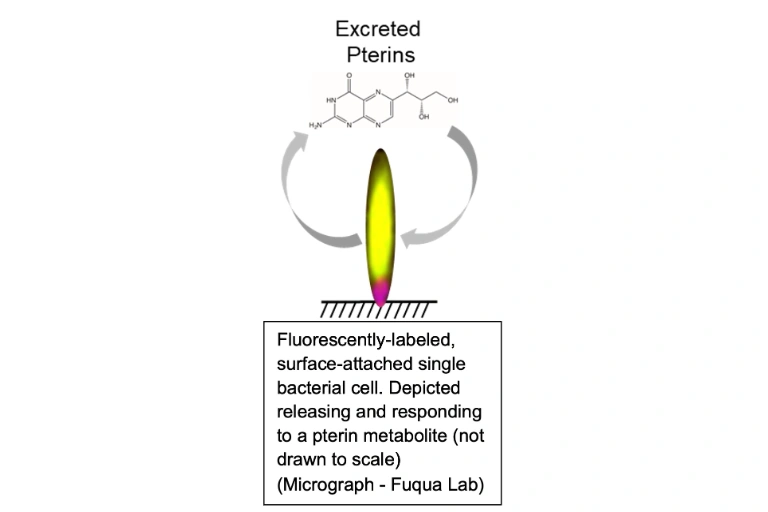
Department of Biology Professor Clay Fuqua and his research team have been funded for a four-year project via an R01 grant from the National Institute of General Medical Sciences at the National Institutes of Health. This project focuses on the role of enigmatic metabolites called pterins that are common to all living systems. Fuqua leads this project in collaboration with scientists from the IU Center for Genomics and Bioinformatics (IU-CGB) and with teams from Virginia Tech (biochemist Dr. Kylie Allen) and Purdue University (synthetic chemist Dr. Arun Ghosh). The Fuqua lab discovered a role for excreted pterins in regulating the formation of bacterial biofilms. The transition of bacteria from a free-living state to a sessile, surface-attached growth mode often results in formation of multicellular biofilms, that are profoundly altered in their physiology and have increased antimicrobial tolerance, making them a major source of persistent infections. Bacterially-produced and excreted pterins have a profound regulatory effect on biofilm formation. Microorganisms synthesize pterins from a branch of the biosynthetic pathway for folate, an essential micronutrient also found in most living systems. The funded work utilizes the experimental model system Agrobacterium tumefaciens, a plant pathogenic bacterium that has been a major focus of the Fuqua lab, but the research team has found that the pterin-specific control circuitry is conserved in a wide range of bacteria, many of which are human or plant pathogens. The study is designed to test and expand the current pterin control model in A. tumefaciens as a prototype for the conserved regulatory systems in other bacteria, using a combination of molecular genetics, biochemistry, synthetic organic chemistry, genomics and bioinformatics. This work will provide numerous insights into this newly discovered and widely relevant mechanism controlling biofilm formation with the potential to lead to new therapeutic targets.
IU biologist leads NIH-funded study on bacterial biofilm regulation
Monday, January 5, 2026

 The College of Arts