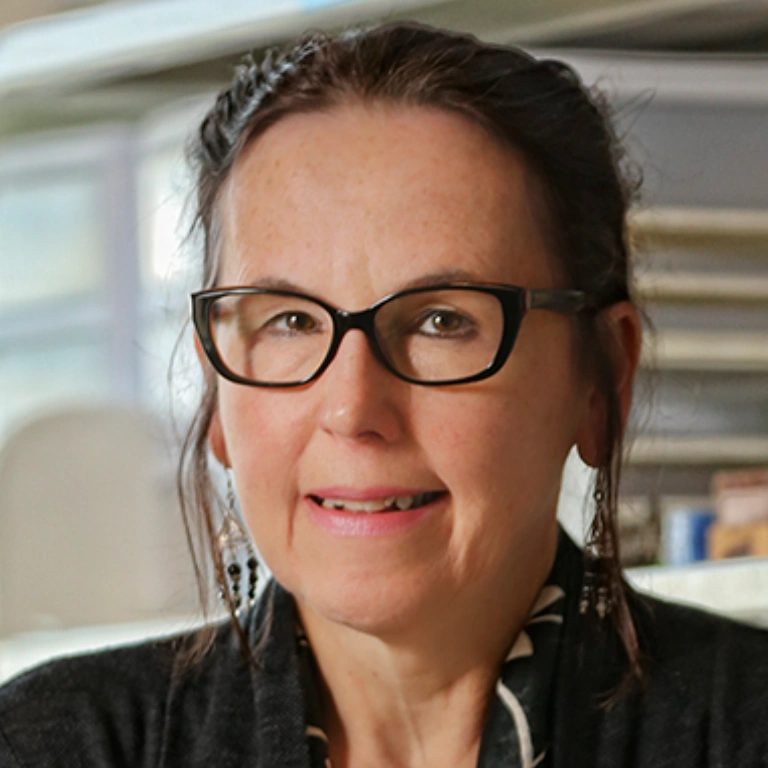
The Department of Biology at Indiana University Bloomington welcomes Dr. Leslie Griffith for the 2025-26 Tracy M. Sonneborn Memorial Lecture Series Tuesday, December 2, at 3:30 PM in Biology Building A100.
Dr. Griffith is the Nancy Lurie Marks Professor of Neuroscience at Brandeis University and Director of the Volen National Center for Complex Systems. Her lab studies behavior at the biochemical, cellular, and organismal levels, using Drosophila as a model, including courtship, sleep, learning, memory, and circadian rhythms. She has made fundamental contributions to understanding mechanisms that link neural activity to behavior.
The Griffith group uses live imaging and electrophysiology to study how experience alters neural circuits and how these changes shape behavior. At the biochemical level, she is interested in the signaling pathways that drive changes in synaptic structure and function.
Dr. Griffith will discuss the first plasticity-related protein to be shown to be locally synthesized in neurons: Ca2+/calmodulin-dependent protein kinase II (CaMKII). Activity-dependent CaMKII synthesis is conserved across phyla and occurs in both pre- and postsynaptic compartments. Activity also has an additional effect on CaMKII that is equally conserved: it causes a subcellular redistribution of the protein. How the dynamic regulation of CaMKII levels and subcellular localization are related is not understood. Dr. Griffith will share recent results from her lab that address these questions.
Abstract: The recognition that cells are capable of locally synthesizing proteins marked a major shift in our thinking about cellular organization. Local translation enables rapid, site-specific responses to activity, supporting structural changes that are required for long-term plasticity.
In contrast to postsynaptic translation, which has been well-studied in the nervous system, evidence for axonal local protein synthesis accumulated more slowly. It is now understood to regulate critical activity-dependent processes in the mature nervous system as well, but its roles and regulatory mechanisms remain far less well-defined.
 The College of Arts